Notícias
RECICLO Achieves Zero Waste Generation Through a Closed-Loop Production Cycle
From recovered solvents to the use of paper as boiler fuel, the company keeps materials in circulation and gives new purposes to what would otherwise be discarded
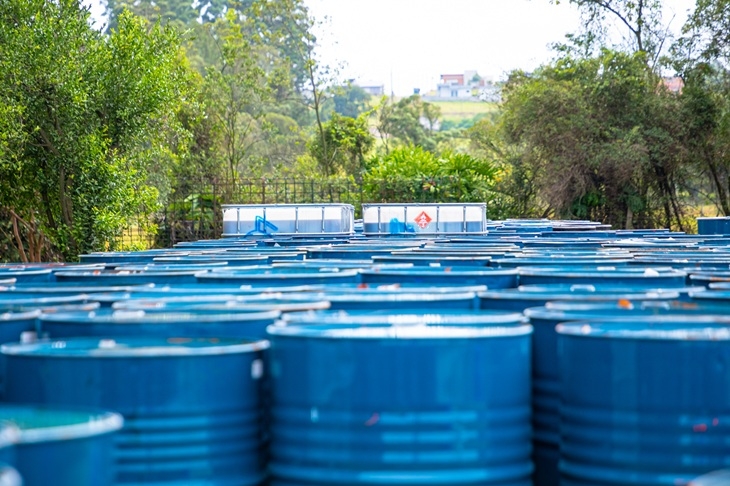
The effort to increase material reuse and reduce waste generation has gained prominence on the agenda of Brazilian industry. At RECICLO, a chemical company based in Santa Catarina, this is no different: the closed-loop production cycle adopted by the company demonstrates that the end of a material’s useful life can represent the beginning of a new process, making its lifespan virtually infinite. As a result, the company has stopped disposing of waste and now puts these materials to new uses.
RECICLO was founded with the purpose of recovering solvents that were previously not reused and did not always receive proper disposal, incorporating a philosophy of waste reduction and material reuse from the very beginning. The process operates as a closed loop: the company produces solvents for the plastic packaging industry and, after use, these products are returned and undergo a recovery process so they can be supplied back to the customer.
To strengthen its sustainable practices, the company began investing in techniques to extend this reuse approach to other waste generated by its industrial operations. RECICLO CEO Alan Fabre explains that the solvents produced and received by the company, as well as the waste generated at its manufacturing site, are reused, recycled or directed to new applications, extending the useful life of these materials.
“Everything here is transformed. We produce and recover solvents, remove contaminants from the product, such as sludge, and send them to companies that use them as raw material. We also recycle other internal waste from our industrial processes, as well as organic waste generated by activities such as tree pruning and grass cutting,” he explains.
Reuse Beyond Industrial Production
A 2019 survey conducted by the Brazilian National Confederation of Industry in partnership with the University of São Paulo shows that 53% of the industries surveyed already reuse materials in their production processes. At RECICLO, however, the effort to reduce disposal extends beyond the production lines.
Administrative materials, such as paper used in the office, are burned in the company’s boiler, where they serve as an energy source. Boiler ash and organic waste generated in the green areas of the facility, which are home to plants and animals such as horses, ducks and dogs, are sent for composting and transformed into fertilizer. Part of this compost is used in the company’s own gardens, while the remainder is donated to the community of Morro da Fumaça, Santa Catarina, extending material reuse beyond the boundaries of the industrial facility.
“RECICLO was an initiative of my father, who has a strong awareness of sustainability, and I am now continuing this work alongside him. We do everything we can to ensure that industrial activity does not harm the environment in which we live, but we cannot change the world alone. That is why part of our work also involves raising awareness among our employees, partners and the surrounding community,” Fabre adds.
RECICLO’s model is based on the understanding that waste does not have to represent the end of a chain. By returning as a recovered product, by-product, raw material, energy source or organic compost, the material remains in circulation, reducing the need for disposal and helping to avoid the predatory extraction of natural resources.
In this way, the company operates at different points along the chain: it produces and supplies solvents, receives the used material, carries out its recovery, directs by-products to other applications and can once again receive materials generated after use.
 Voltar